Size guide · Food & Snack Mylar Bags
Cereal Mylar Bags Sizes & Dimensions: A Complete Guide
By the Mylar Bags NYC team · · 6 min read

In this guide
- Why size matters for cereal mylar bags
- Standard cereal mylar bags size chart
- How pouch dimensions work
- How to measure for cereal mylar bags
- A worked example
- Choosing a size by fill weight
- Fill weight vs volume
- Sizing for multipacks and bundles
- Shelf presentation
- Shipping and storage
- Film thickness by size
- Features that change sizing
- Sizes for different sales channels
- How size affects cost
- Custom sizes vs stock sizes
- Size checklist before you order
- Common sizing mistakes
- Questions to ask your packaging supplier
- In summary
Choosing the right size is one of the most important decisions you'll make when ordering custom cereal mylar bags. Get it right and your cereal, granola and muesli look full, seal cleanly and stay fresh. Get it wrong and you pay for wasted film, bags that look half-empty, or pouches that won't seal.
This guide covers standard sizes for cereal mylar bags, how to measure for a pouch, how fill weight maps to dimensions, and the mistakes we see most often.
Why size matters for cereal mylar bags
A bag that's too large looks under-filled on the shelf and wastes film, ink and shipping space. A bag that's too small is hard to fill, strains the zipper and seals, and can leave too little headspace for a clean heat seal.
Flexible packaging is sized by width, height and gusset, not by volume alone. The density of your cereal, granola and muesli matters as much as the weight: a pound of coffee beans needs a very different bag from a pound of cereal or marshmallows.
Standard cereal mylar bags size chart
These are the sizes we're asked for most often. Dimensions are width x height, plus bottom gusset where listed.
| Size | Dimensions (W x H x gusset) | Best for |
|---|---|---|
| 4 oz | 5 x 8 x 3 in | snacks, candy |
| 8 oz | 6 x 9 x 3.5 in | cookies, jerky |
| 16 oz | 7 x 11.5 x 4 in | 1 lb products |
| 32 oz | 9 x 13.5 x 4.75 in | 2 lb bulk |
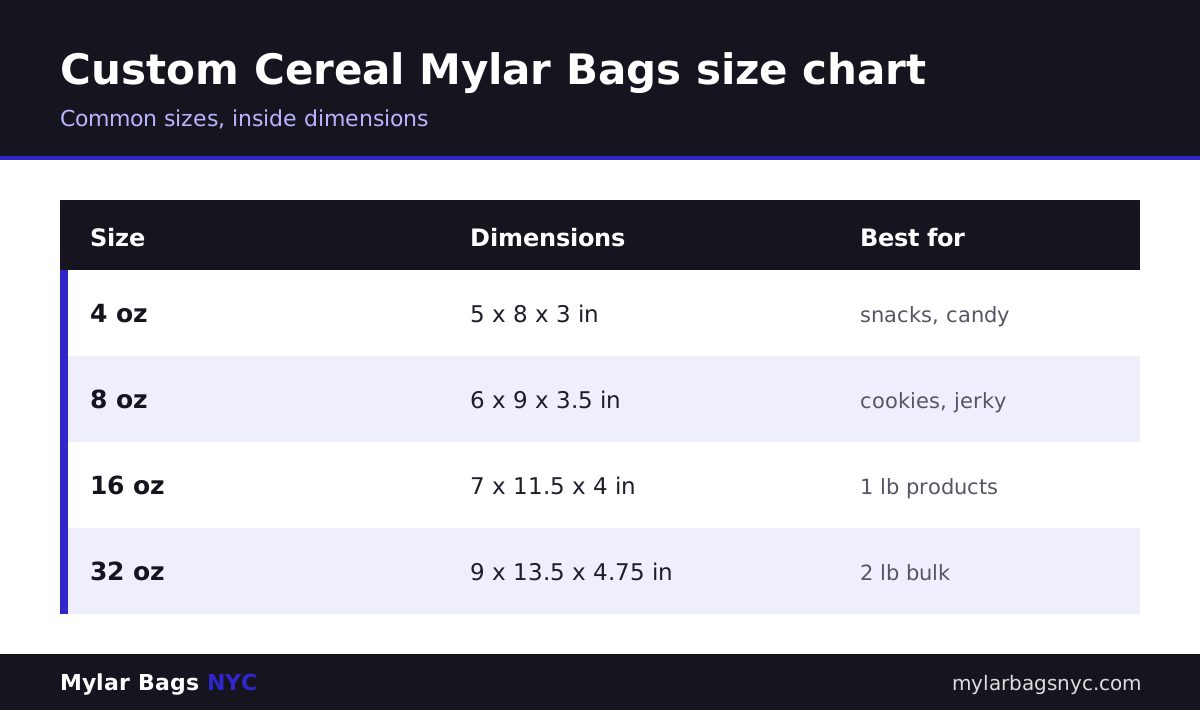
Treat these as starting points and always test with your actual product.
How pouch dimensions work
- Width is measured across the front of the bag, side seal to side seal.
- Height is measured from the top edge to the bottom, including the gusset when it's folded flat.
- Gusset is the depth of the bottom panel that lets a stand-up pouch stand and expand.
- Seal areas take up roughly 3/8 in on each side and at the top, reducing usable space.
- Zippers sit 1 to 1.5 in below the top and need clearance above the fill line.
How to measure for cereal mylar bags
- Weigh a typical fill. Use the exact amount of cereal, granola and muesli you'll sell in each bag.
- Test in a sample bag. Pour the product into a blank bag of a likely size and see how full it looks.
- Leave headspace. Keep at least 1 in between the fill and the zipper, and more for heat sealing.
- Check the shelf. Make sure the bag stands upright and fits the shelf or display height.
- Confirm with a blank sample run before printing a large order.
A worked example
Say you sell a mid-size fill of cereal, granola and muesli. You test it in the 8 oz size (6 x 9 x 3.5 in) and it fills about 75 percent of the bag, leaving room for the zipper and seal. That's a good result: the bag looks full, closes easily and stands neatly on the shelf.
If the product sits well below the window or looks loose, step down a size. If it presses against the zipper, step up or add gusset depth.
Choosing a size by fill weight
Smaller fills often suit the 4 oz (5 x 8 x 3 in). Your core product usually fits the 8 oz (6 x 9 x 3.5 in). Larger fills and family packs move up to the 16 oz (7 x 11.5 x 4 in) or 32 oz (9 x 13.5 x 4.75 in).
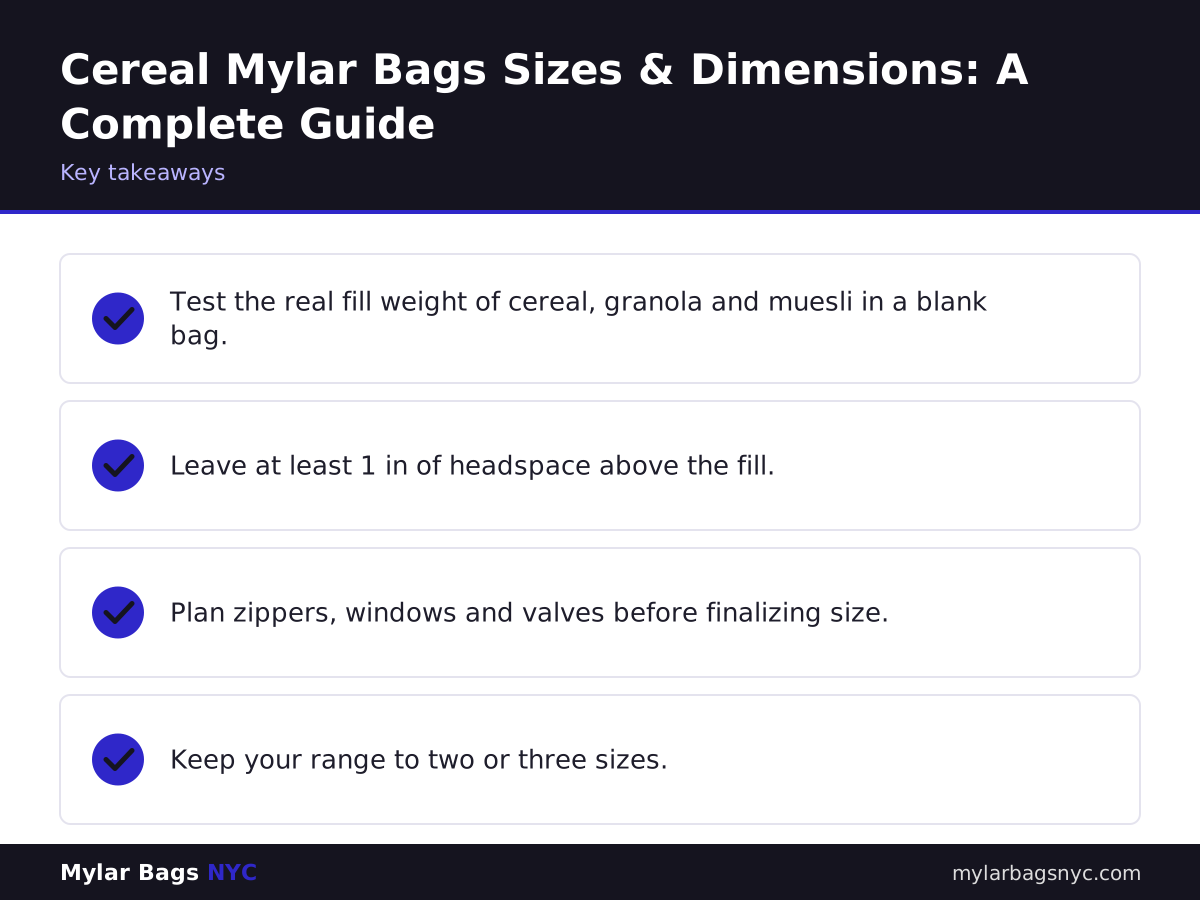
Keep your range small. Two or three sizes usually cover a full line and let you order higher quantities of each.
Fill weight vs volume
Two products with the same weight can need very different bags. Dense products like coffee beans, sugar or granola take up less space per ounce, while light, airy products like cereal, popcorn, marshmallows or cannabis flower need much more room. That's why the same 16 oz label can mean a 6 x 9 in bag for one brand and a 9 x 13 in bag for another.
For cereal mylar bags, weigh a typical fill, pour it into a blank bag and see how full it looks. Aim for roughly 70 to 80 percent full, with the product sitting below the zipper and any window showing a good amount of product.
Sizing for multipacks and bundles
If you sell cereal mylar bags in bundles, sample packs or variety sets, plan sizes together. Smaller bags that fit neatly inside a retail box or mailer create a premium unboxing, while matching widths make a variety pack look organized. Ask us to quote bags and boxes together so dimensions line up from the start.
Shelf presentation
A bag that looks full and stands straight signals quality. On a shelf or in a display case, the front panel should face customers without slumping. A deeper gusset helps tall bags stand; a shorter, wider bag can look more premium for small fills. Check how cereal mylar bags look next to competitors at the same price point.
Shipping and storage
Flat bags ship and store efficiently before filling. After filling, consider how bags pack into cartons: consistent sizes stack neatly and reduce void fill. For e-commerce, flat or low-profile pouches fit mailers better and lower shipping costs. Store unfilled bags in a cool, dry place away from sunlight.
Film thickness by size
- Small bags: 3 to 4 mil film is usually enough.
- Medium bags: 4 to 5 mil gives a firmer feel and better puncture resistance.
- Large or heavy fills: 5 to 7 mil prevents stretching and tears.
- Long-term storage: thicker foil laminates provide the best barrier.
For cereal mylar bags, we usually pair the size with window panels so the bag performs well.
Features that change sizing
Windows, zippers, valves, spouts, hang holes and tear notches all take up space or affect where artwork can go. A valve needs a clear area on the front, a hang hole needs space above the zipper, and a spout changes the usable height. Plan features before finalizing dimensions.
Sizes for different sales channels
- Retail shelves: stand-up pouches with strong front panels.
- Peg displays: flat or stand-up pouches with hang holes.
- E-commerce: flat, lightweight sizes that fit mailers.
- Dispensaries: compliant sizes by weight, with child-resistant closures where required.
- Wholesale and bulk: large or gusseted bags for food service.
How size affects cost
Film is priced by area, so every extra inch on cereal mylar bags adds cost across thousands of units. Larger bags also take more space in cartons and storage. Choose the smallest size that fits your fill comfortably and consolidate to fewer sizes to lower unit cost.
Custom sizes vs stock sizes
Stock sizes are fast but rarely perfect. Custom cereal mylar bags are printed to your dimensions, so the bag looks full and on-brand. With minimums from 100 units, custom sizing is practical for new brands. If you're between sizes, ask us for blank samples to test first.
Size checklist before you order
- Have you tested the actual fill weight of cereal, granola and muesli?
- Is there at least 1 in of headspace above the fill?
- Have you allowed for zipper, valve, window or hang hole?
- Does the bag fit your shelf, display or mailer?
- Have you limited your range to the sizes you need?
- Would a blank sample help confirm the fit?
Common sizing mistakes
- Sizing by volume without testing the actual product.
- Forgetting seal and zipper areas.
- Choosing a gusset that's too shallow for the bag to stand.
- Ordering too many sizes and splitting quantities.
- Skipping a blank sample on a large order.
Questions to ask your packaging supplier
- Which film structure and thickness do you recommend for cereal mylar bags?
- Can you send blank samples in two or three sizes?
- What are the price breaks at 500, 1,000 and 5,000 units?
- Is digital or rotogravure printing better for my quantity?
- How long is production after proof approval?
Good suppliers answer these clearly. At Mylar Bags NYC we include size and film recommendations with every quote.
In summary
The best size for cereal mylar bags fits your fill with room for a clean seal, stands neatly, and suits how you sell. Start with the chart above, test with your real product, and order a blank sample if unsure.
Ready to order? Request a free quote with your fill weight and we'll recommend a size within one business day.
FAQ
Frequently asked questions
What is the most popular size for cereal mylar bags?
The 8 oz size, 6 x 9 x 3.5 in, is one of the most requested, but the right size depends on your product's density.
Can I order cereal mylar bags in a custom size?
Yes. Every order is printed to your dimensions, from 100 units.
How much headspace should I leave?
At least 1 inch between the fill and the zipper, and more if you heat seal above the zipper.
Can I get blank samples?
Yes. We can send blank bags in a few sizes so you can test your fill.
How much do custom cereal mylar bags cost?
Price depends on size, quantity, film, printing and features. Larger runs lower the unit price. Send your specs for tiered pricing within one business day.